Flat pricing, variable costs: the AI margin problem hiding in your product
When your product calls an LLM, every customer carries a cost that changes with how they use it. On a flat plan, your heaviest users can quietly turn profitable accounts into losses.

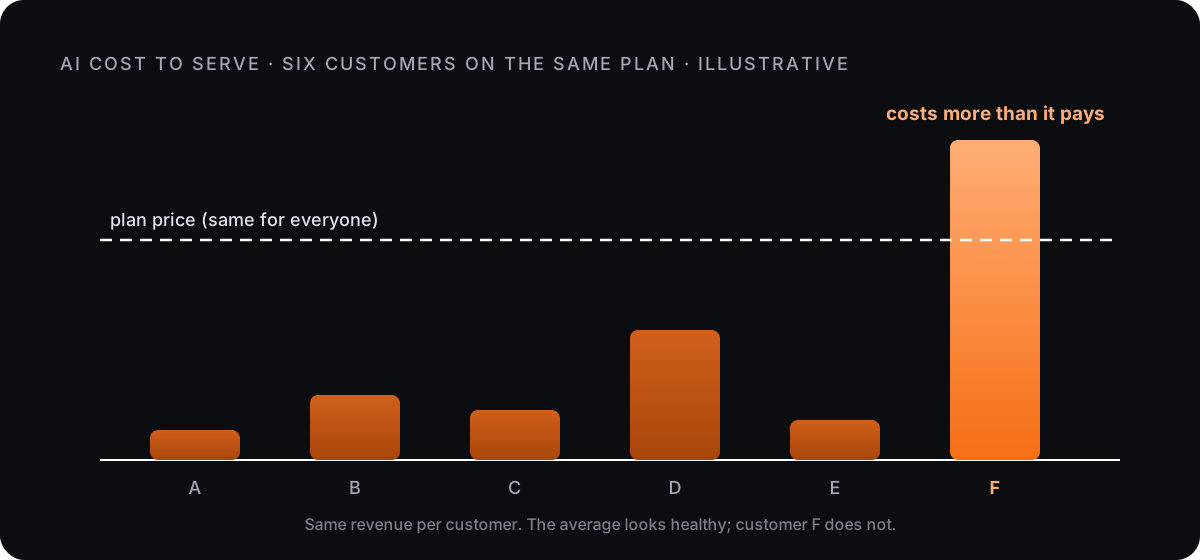
If your product uses AI, your cost to serve each customer is no longer fixed, but your price probably is. Two customers on the same plan can generate wildly different model bills. One might cost you almost nothing in AI. Another might cost more than they pay. On an average, both disappear.
That's the AI margin problem. It doesn't show up as a bug or an outage. It shows up months later as a gross margin that won't move the way the spreadsheet said it would.
Software used to have near-zero marginal cost
The economics of SaaS rested on a simple fact: serving one more customer, or one more request, cost almost nothing. That's why flat per-seat and per-plan pricing worked so well.
AI breaks that. Every chat answer, summary, search or agent run calls a model, and every call is billed by the token. The more a customer uses your AI features, the more you pay. Heavy users aren't just more engaged; they're more expensive.
Even AI companies had to change their pricing
The clearest evidence comes from AI tool vendors themselves. In 2025, Cursor moved from request-based limits to usage-based pricing, explaining that the hardest requests cost far more than simple ones. Anthropic added weekly limits to Claude Code to rein in a small group of very heavy users, with extra usage sold at API rates.
These are companies with deep insight into model costs, and they still had to rework their pricing once real usage arrived. If your product embeds AI behind a flat plan, the same pressure applies to you, just less visibly.
Why the problem stays hidden
Most companies can't see AI margin per customer, for structural reasons:
- Model providers bill you in total. The invoice shows tokens and models, not which customer they were for.
- Revenue lives somewhere else. Billing data sits in Stripe or Razorpay; AI usage sits in logs, if it's recorded at all.
- Averages look fine. Total AI cost divided by total revenue can look healthy while a handful of accounts lose money every month.
- Usage changes faster than pricing. A customer who rolls your AI feature out to their whole team can multiply your cost long before their next renewal.
Why it will get worse
Several trends are pushing AI cost per customer up and making it less predictable:
- Agents do more per request. An agent that plans, searches, calls tools and retries can make many model calls for what the customer sees as one action.
- Agents call other agents. Multi-step systems multiply cost in ways that are hard to predict from the outside.
- Customers learn to rely on AI features. The better your feature, the more it gets used, and on a flat plan, success costs you more.
- Spend is under more scrutiny. Gartner expects end-user spending on AI models and platforms to grow about 63% in 2026, and notes that enterprise AI budgets are "coming under greater scrutiny". Your investors and your finance team will ask about AI margins, if they haven't already.
What waiting costs
- Contracts lock in. Annual deals signed without cost data can run for a year at a loss.
- Pricing changes get harder. It's far easier to launch with usage tiers than to introduce them to customers used to "unlimited".
- You optimise blind. Without knowing which customers and features drive cost, engineering effort on caching or model routing goes to the wrong places.
- You can't prove a feature is worth it. "Our AI feature is popular" isn't the same as "our AI feature is profitable".
Why start now
You don't need perfect data to start, but you do need the right foundations before usage grows:
- Tag every model call with the customer it was made for, at the point in your code where it happens.
- Price every call with the real rates, including cached tokens.
- Join AI cost to revenue for each customer, net of tax.
- Pick a threshold: the share of revenue above which an account needs attention, and review the accounts above it every month.
Doing this while you have tens of customers is a small project. Doing it with thousands, after pricing has been set, is a much bigger one.
What to do with the answer
Once you can see AI margin per customer, the options are practical rather than drastic:
- Pricing tiers or usage limits for customers whose usage outgrows their plan
- Prompt caching for customers who ask similar things repeatedly
- Model routing, so simple requests go to smaller, cheaper models
- Smaller context, trimming what you send with each request
- Per-run limits, so one runaway agent can't dominate a customer's cost
Where TraceIQ fits
TraceIQ links every traced agent run to the customer it served, prices each call, brings in revenue from Stripe and Razorpay, and shows AI cost against revenue for every customer, so the accounts that cost more than they pay stand out. The goal is simple: know your AI margin before your pricing, your contracts or your board decide it for you.
FAQ
What is AI margin?
The gross margin on a customer or product after the AI cost of serving it: revenue minus AI cost and other cost to serve, divided by revenue.
Should we just switch to usage-based pricing?
Not necessarily. Many customers prefer predictable plans. Measure AI cost per customer first; it will tell you whether you need tiers, limits, usage pricing above an included amount, or simply better caching.
When should a startup start tracking AI cost per customer?
As soon as AI is part of the product. Tagging calls with the customer is easiest when the feature is built, and the data shapes your first pricing decisions.