AI spend is the new cloud bill, and most companies can't see it yet
AI has quietly become a metered utility spread across seats, usage bills and agents. Cloud took years to get out of control. AI is moving faster, and the time to get visibility is before the CFO asks.

Most companies already spend real money on AI, and very few can say where it goes. It arrives as seat licences for coding and chat tools, usage charges on top of those seats, and API bills from agents your engineers built. Each lands in a different place, owned by a different person. Added up, it behaves exactly like the early cloud bill: it grows quietly, nobody owns it, and by the time someone asks, the habits that made it are already set.
This post is about why that matters now, before it becomes a problem you have to explain.
AI stopped being software and became a utility
Traditional software has a predictable shape: a price per seat, renewed once a year. AI is different. Every question, every code change and every agent run consumes compute that someone pays for, by the token.
The vendors know this, and their pricing is moving with it:
- In mid-2025, Cursor moved its plans from request-based limits to usage-based pricing, explaining that the hardest requests cost far more than simple ones. The rollout was rocky enough that the company apologised and refunded unexpected charges.
- In the same summer, Anthropic added weekly limits for Claude Code subscribers, saying they would affect about 5% of users, and offered extra usage at standard API rates for those who hit them.
The pattern is clear. Seats are becoming a floor, not a ceiling. Above that floor, cost scales with how much your people and your products actually use AI.
Everyone is starting to manage it, quickly
This isn't a niche concern any more. The FinOps Foundation's 2026 survey of 1,192 practitioners found that 98% now manage AI spend, up from 31% just two years earlier, and named FinOps for AI the top forward-looking priority.
The spend behind it is growing fast too. Gartner forecasts end-user spending on AI models and platforms will grow about 63% in 2026, and its analyst put the mood plainly: "Enterprise AI budgets are coming under greater scrutiny."
Scrutiny is the key word. Sooner or later, someone in your company will ask what you spend on AI and what you get for it. The only question is whether you can answer.
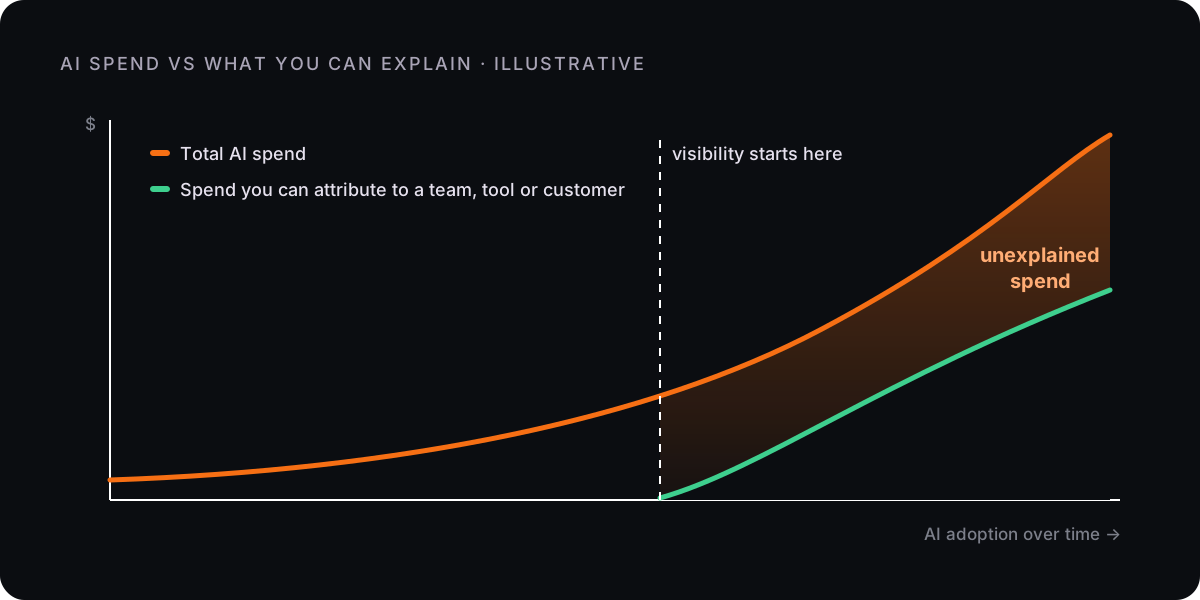
Why AI spend is harder to see than cloud spend
Cloud cost was hard, but it at least arrived on one bill from a handful of providers. AI cost is scattered in ways that make it harder:
- It's split across many vendors. A typical team pays for a coding assistant, a chat assistant and one or more model APIs, each with its own admin console and reporting format.
- It's split across many shapes. Seat fees, usage beyond the seat, and per-token API charges can't simply be added together without care. Some vendors report "usage value" at API prices that you never actually paid.
- The bill doesn't name the team. A model provider invoice shows tokens and models, not which product, workflow or customer sent them.
- Some of it is a cost of revenue. An AI agent answering your customers isn't an internal tool. It belongs next to revenue, and mixing it with employee tools hides both.
- Usage is uneven. A small group of heavy users or one runaway agent can drive a large share of the bill. Averages hide them.
What waiting actually costs
The direct cost is obvious: money spent on idle seats, oversized models and agents that loop. The indirect costs are bigger, and they compound.
- You lose your baseline. You can't show that a change saved money if you never measured what came before. Every month without data is a month you can't compare against.
- Attribution gets harder to add later. Tagging an agent with its team or customer takes minutes when you build it and weeks when you retrofit it across a dozen services.
- Habits set early. Teams that never see their AI cost don't learn to think about it. Changing behaviour after a year of "it's free" is far harder than shaping it from the start.
- Budget conversations happen without you. When finance finally asks, the answer becomes a cut across the board instead of a targeted decision based on what's working.
- Pricing decisions go unexamined. If AI is part of your product, every month without per-customer cost data is a month you may be underpricing it.
Why today is the right time
Starting now is cheaper than starting later for one simple reason: the amount of AI usage you need to untangle only grows. Today it's a few tools and a couple of agents. In a year it may be every team, every product and agents calling other agents.
Getting started doesn't require a big project. It requires answering four questions:
- What do we spend on AI in total, across every tool and agent?
- Who does each dollar belong to: which team, person, product or customer?
- Which costs are growing fastest, and is that growth expected?
- What are we getting for it?
If you can answer all four for last month, you're ahead of most companies. If you can't, that's the place to start.
What good looks like
Whatever you use, a healthy setup has a few things in common:
- One view of every AI dollar, from seats, usage and APIs, in one consistent definition of spend.
- Attribution by default: person, team, product and customer, with nothing falling through the cracks.
- Employee AI and customer AI kept apart, so operating cost and cost of revenue each stay honest.
- Budgets with early warning: forecasts and alerts before a limit is reached, not after the invoice arrives.
- Value next to cost: pull requests, tickets, revenue, so spend can be judged, not just counted.
This is the gap TraceIQ was built to close: every AI dollar across employees, agents and customers, attributed and kept within budget. Whether you use us or build it yourself, the important thing is to start measuring before the bill makes the decision for you.
FAQ
Isn't our AI spend too small to worry about yet?
That's the best time to start. Setting up visibility while spend is small is quick, gives you a baseline, and builds the habits that keep it under control as it grows.
Who should own AI spend?
Usually a shared responsibility: finance owns the budget, engineering owns the systems that create the cost, and each team owns its own usage. The key is that everyone works from the same numbers.
How is managing AI spend different from cloud FinOps?
The principles are the same: visibility, attribution, accountability. But AI cost is spread across more vendors and more pricing models, and part of it is a direct cost of serving customers, which makes attribution even more important.